When you build an app in the Atmosphere, it's not trapped in its own walled garden like traditional apps. Apps can easily interoperate and create new experiences by combining existing apps' data. Your app can do what it does well, and pull in capabilities from the network.
One area where the network already provides some nice capabilities is app feedback. Let's look at two ways to tap into it — without making your users jump through hoops.
Any time you build an app, you'll want to collect information from users about bugs and features they would like to see you build. Having the board public builds trust between you and your users — they like to know you listen.
Currently, you can create a space on userinput.app and start collecting whatever feedback you want from your users.
I typically add at least these three tags:
bug: for reporting bugsfeature: for suggesting new featuresquestion: for general feedback
You could stop there — but because the network is open, you can let users submit feedback without ever leaving your app.
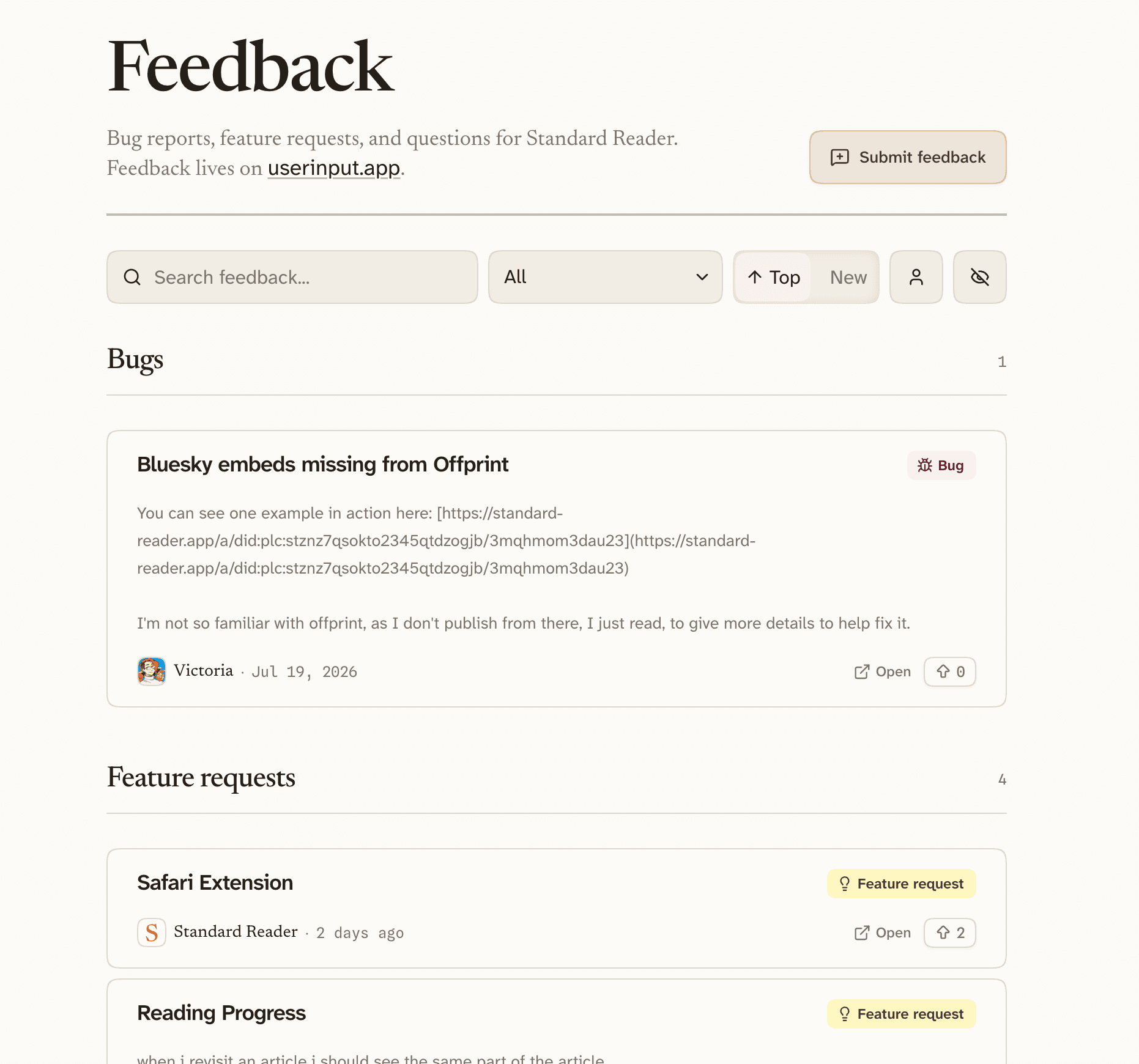
To actually write app.userinput.* records, though, you need to request permission from the user.
You could request all perms your app might ever need when a user first logs in, but that's not the best user experience.
A large list of scopes can be scary, especially if the user doesn't understand why they're being asked for each one.
To get around this, you can use progressive scoping.
- Request basic permissions on login
- When a user wants to access a feature that requires more permissions, request them on-demand
- Note that you've requested the additional scope so that on future logins you re-request it
Now that you have the basic permissions, you can start writing app.userinput.* records and the user doesn't have to leave the app!
The lower the friction we have for feedback, the more we'll get. And in the Atmosphere, that integration can look like whatever you want, fitting seamlessly into your app's branding.
The Atmosphere is a sprawling, interoperable ecosystem — which can be hard to navigate, especially for the not-so-tech-savvy.
That's why I built atstore.fyi, the "App Store" for Atmosphere apps. It's a simple-to-understand interface that lets you discover apps that work with your Atmosphere account, and it instantly shows the power of the network.
But atstore.fyi also opens up another vector for feedback: reviews. Reviews are a great way to get more high-level feedback from users, and it always feels great to read some kind words from a user who's using your app.
When a user uses Standard Reader for a few days, they'll see a toast that asks them to leave a review. If they click it, they'll be shown a Dialog with a form to leave a review. If they dismiss it, we don't show it again.
In the first few days, we've already seen 10 reviews come in! Honestly, an amazing success — there was very little movement before the notification was shown. I truly do appreciate all the kind words too. It's an amazing feeling to build something that people actually use.
This is just the beginning of what you can do when you have access to the network's data and capabilities. I believe we should be making apps that are interesting without even mentioning "atproto". But leaning into what makes this protocol unique is what turns a good app into a great one.
Backlinks
Enjoying the blog?
Subscribe to get new posts delivered straight to wherever you read standard.site publications.
Subscribe